


Let’s assume, for argument’s sake, that we want to eat food that doesn’t make us sick. And let’s say that we want an FDA and food safety laws that help us accomplish that modest goal, rather than get in the way.
We might start by writing a few common-sense provisions into law:
Make it illegal to sell spoiled, putrid food.
Create a food system that fills our supermarkets with healthy food.
Definitely don’t allow for the unfettered sale of factory-produced foods and ingredients that, according to FDA, contribute to “skyrocketing rates of chronic disease” including (FDA’s tally) the one in 20 Americans with cardiovascular disease, 38 million with type-2 diabetes, over 2 million diagnosed with cancer in 2025 alone, and the three-fourths of our youth who are ineligible for military service in significant part due to obesity and other diet-related conditions.1
Remarkably, as basic and common-sense as these three provisions are, current federal law includes only #1. It is, in fact, illegal to sell a food that contains any “filthy, putrid, or decomposed substance.” These foods are called “adulterated,” and FDA has the authority to stop their sale.2
Numbers 2 and 3, on the other hand, are distant wishes. The majority of foods sold in supermarkets, and the majority of calories Americans consume, are “ultraprocessed.” This industrial catch-all term includes “perfect caloric torpedoes” and ingredients at the root of obesity, type-2 diabetes and more. Doctors and scientists call them “carriers of fat, sugar, and salt” and “bliss point” pleasure foods that lead us to eat an average of 500 extra calories every day.3
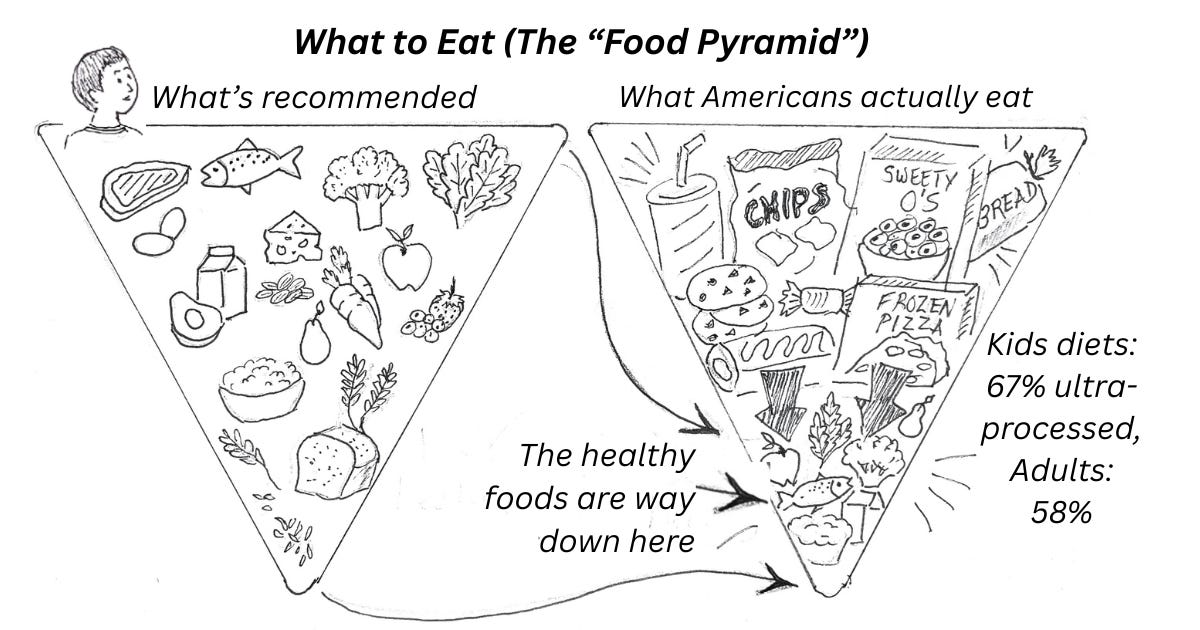
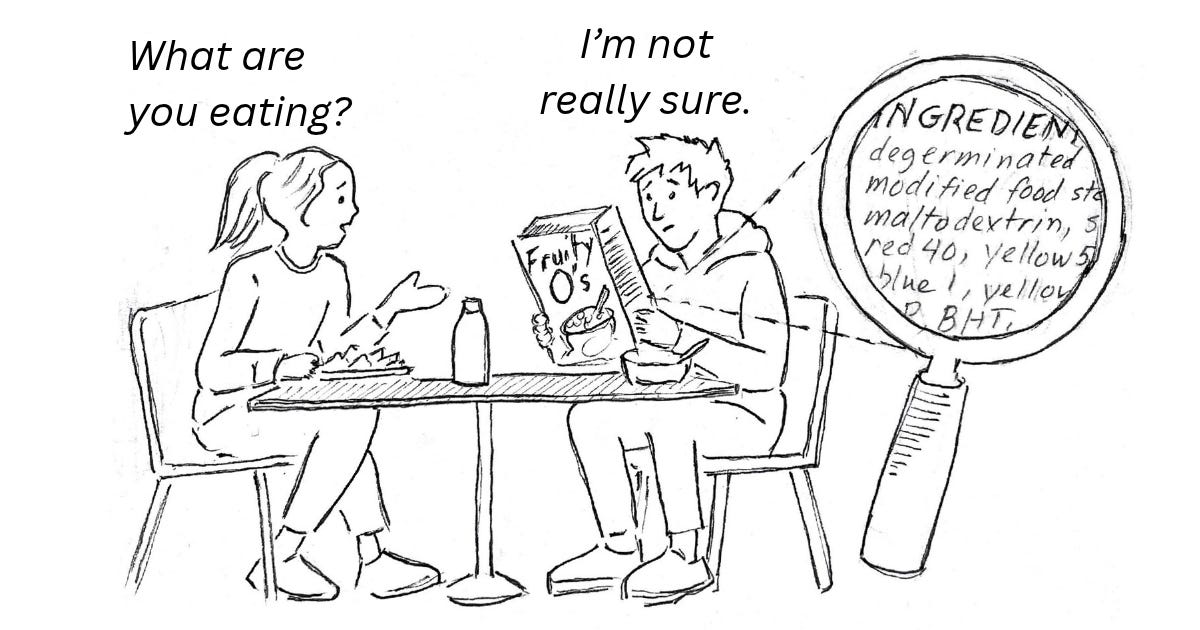
Even when we think we’re eating something healthy, like our go-to’s with “natural” and “healthy” halos adorning the wrapper or box, we could be falling into the ultraprocessed trap (I’m looking at you, energy bars and breakfast cereals).4
The rhetoric surrounding ultraprocessed foods (UPFs) can sound overblown. But consider the possibility that it sounds so bad because it actually is that bad. A former FDA Commissioner has laid out the evidence for us, you’ll learn below.
But here’s the remarkable part: We may be on the brink of a major shift in American food policy. If FDA starts applying our food safety laws to UPFs as these laws were intended - as it has indicated it will do in a draft document obtained by the Washington Post5 - the consequences for the nation’s food supply could be enormous. Closer to home, such a shift would profoundly change what we all eat every day.
Here’s why: Tackling UPFs means taking on 58% of the calories Americans consume, 67% of our children’s diets, and around 70% of the food supply in the United States.6
At the heart of this story we find that Congress and public health officials didn’t set out to create a system that has made so many Americans sick. So what went wrong, why haven’t we fixed it, and what could the future look like?
What do we do when the rhetoric is true?
When it comes to UPFs and our health, the stark warnings cross party affiliations and presidential administrations:
“Highly palatable” UPFs cause “devastating long-term health consequences,” says Dr. David Kessler, FDA Commissioner under Presidents George H.W. Bush and Bill Clinton.7
“If a foreign adversary sought to destroy the health of our children, to cripple our economy, to weaken our national security, there would be no better strategy than to addict us to ultra-processed foods. It’s shocking that our own government helped to drive these cataclysmic changes in our diet,” says Robert F. Kennedy Jr., Secretary of Health and Human Services under President Trump.8
Ok, take a deep breath and maybe a bite of an apple. Here we go!
Welcome to our food safety loopholes, where healthy food goes to die
Let’s spend a minute back in 1958, when Congress passed the Food Additive Amendments (FAA). A postwar chemical industry had an increasing appetite for engineered foods. Congress saw a need to weigh in on behalf of public health.
Dow Chemicals, Monsanto, Eastman Kodak, and Union Carbide among others were all in the food game. Their novel inventions kept food moist, mixtures mixed, colors bright, flavors big, and spoilage at bay. They synthesized new ingredients from sources like petroleum, chemically modified fats, and even coal tar, producing an array of chemical additives and stand-ins for the sugar, eggs, flour and butter staples of the past.
Food law at the time placed the burden on FDA to prove ingredients harmful after they went into use. Congress recognized that some kind of pre-market safety review was needed. The 1958 Food Additive Amendment gave FDA the mandate and authority to determine if these novel additives were, in fact, safe. But FDA had to know what was being added to food in order to do that. Congress left some loose ends there and they ended up on our plates.
What would happen if food companies could legally use unlimited numbers of secret ingredients?
The intention was good: Congress wanted FDA to review the safety of new food additives before they hit the market, and to ensure that what was already used in food was safe as well. But lawmakers didn’t want FDA spending time reviewing familiar ingredients with long histories of safe use, like olive oil and baking soda. So they wrote an exception into the 1958 Food Additives Amendment, called the GRAS provision (Generally Recognized as Safe).
If qualified experts generally agree that an ingredient is safe for its intended use, the reasoning went, there’s no need for FDA to review and approve it first. Nearly 200 familiar ingredients and other established food substances filled FDA’s first GRAS list.
But GRAS status wasn’t limited to the substances on that list. Going forward, companies could decide that their own new food chemicals qualified as GRAS, allowing their use in foods without FDA approval. Then in 1997, FDA proposed a new system that made it easier for companies to voluntarily report those decisions instead of petitioning FDA for formal confirmation.9
Congress envisioned GRAS as an exception to the rule, not an alternative regulatory system for the food industry’s expanding inventory of chemicals. Yet companies have stretched that exception into a regulatory sinkhole that the lawmakers of 1958 would barely recognize.
As it stands, companies self-declare GRAS status - that is, declare that their own chemical is safe enough for food - for 99 percent of all new food chemicals. These aren’t all just new varieties of olive oil and vinegar. They are often factory-produced chemical food ingredients far removed from fields and farms. There is no FDA safety review required. FDA, inarguably under-resourced and arguably under-motivated, has not intervened. The loophole has become the law.10
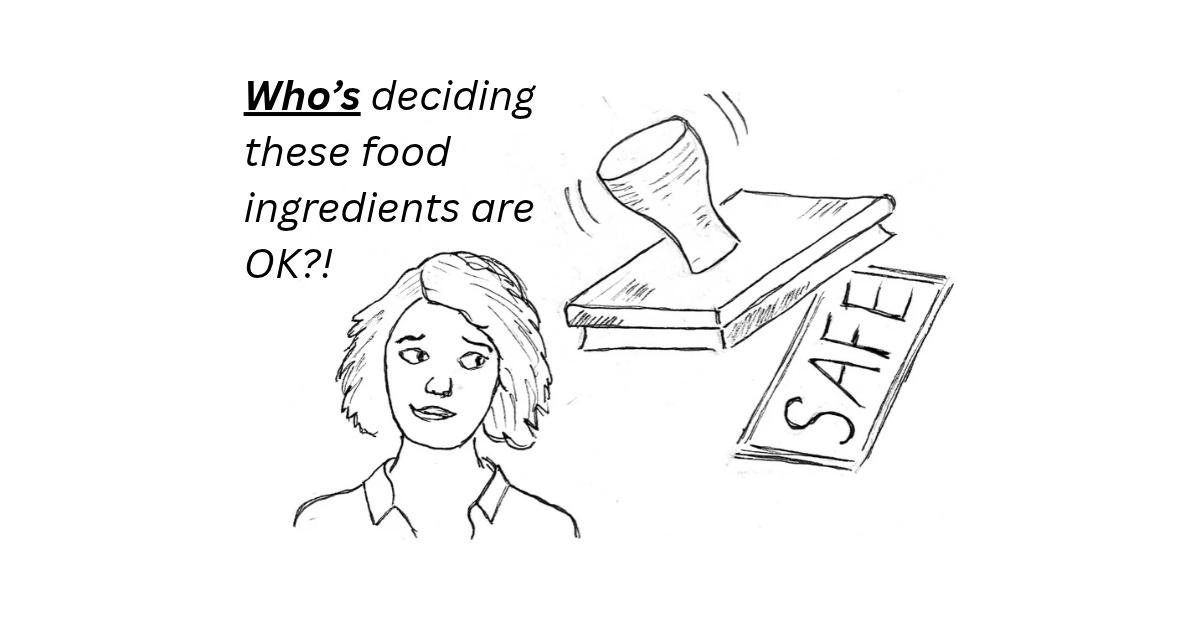
Here’s the 25-year track record: Companies have self-approved 863 food chemicals, while petitioning FDA to conduct its own safety reviews - the standard track Congress had envisioned - for only 10, according to analysis by the public-health watchdog and research organization Environmental Working Group.11
And it gets worse - 99 percent self-approved is an underestimate. An unknown number of companies’ self-GRAS declarations have not been submitted to FDA - submission is voluntary. Companies have added to food an unknown number of new chemicals through this secret but perfectly legal pathway.
The end result? FDA does not have a full list of chemicals used in food. And they don’t know how much of the full list they are missing. It’s a mystery.
Consider this admission from one of FDA’s top food officials during an October 2026 webinar:
“…our lack of a complete understanding of what substances are being used in the food supply impedes our ability to efficiently carry out our role to prohibit the use of unsafe additives in food and protect public health.”12
FDA is like an air traffic controller expected to prevent collisions with half its windows and monitors blacked out.
And sometimes there’s a crash. In 2022, Daily Harvest sold packaged protein crumbles made with a novel ingredient called tara flour that sickened hundreds of people, sending 133 to the hospital. Seventeen suffered acute liver injury. Behind the scenes, this novel ingredient had entered the food supply without FDA review or notification. When the agency investigated, it found that tara flour lacked the evidence needed to qualify as safe under the GRAS standard. Until the illnesses emerged, FDA had no way of knowing that the ingredient was even being sold.13, 14
The crumbles are off the market now. The GRAS loophole remains wide open.
Reality recap
This is our shared reality: FDA has a mandate to ensure that our food is safe to eat, yet doesn’t have a full account of the chemicals in it. Companies, not FDA, green-light the safety of food chemicals 99% of the time. Companies are not required to tell FDA what they are adding to food.
Does it sound like an honor system that could fail us? Rife with conflicts of interest? At the very least, not ideal?
Let’s look at how this system spawned UPFs, and then we’ll explore the prospects for change.
The 1980s: Enter the imposter ingredients behind our obesity epidemic, standing in for table sugar and stone-ground flour
While people marveled over personal computers, mega shopping malls, and MTV, a largely unnoticed, less glitzy revolution was sweeping through our 1980’s-era supermarkets: corn syrup sweeteners were replacing table sugar (sucrose) in our packaged foods.
Companies had long known how to strip corn kernels of fiber, protein, and fat to leave mostly starch, and then to chemically crack that starch apart to form corn syrup. But by the 1980s new methods allowed for the mass production of corn-derived syrups and powders. They were endlessly customizable, fine-tuned for sweetness and smoothness, with an easy flow through equipment and a notable boost to processed food’s softness, moistness, chewiness, shelf life, and calorie density, often at a lower cost than table sugar.15
These sweeteners debuted on food labels as a diverse cast of industrial ingredients - high fructose corn syrup, glucose syrup, corn solids, maltodextrin, and more. Between the mid-1970s and the late 1980s, the amount of high-fructose corn syrup available in the U.S. food supply surged more than 17-fold, from 2.8 to 49 pounds per person annually, according to federal data. We had become a corn syrup country.16
In parallel, a second industrial revolution was taking over both flour and starch. In the 1980s, new machinery and computerized equipment gave UPFs a host of “extruded” starch and flour mixtures that are now the backbone of puffed snacks, cereals, vegetable protein and more. Using high pressures, temperatures reaching 400 degrees F, and mechanical force, flour and starch structures are broken apart to form a melted mass or gel. Mixed with other ingredients, the dough is squeezed through industrial cookie cutters. Then it’s puffed, sliced, and toasted into a seemingly endless variety of whimsical shapes and childhood favorites, including Cheetos, Bugle snacks, and Froot Loops.17
Many of these sweeteners and processed flours and starches have enjoyed GRAS - Generally Recognized as Safe - status for decades. But half a century of research, coupled with soaring rates of metabolic disease, has cast that designation in a different light. These chemicals have become poster children for a food safety system that has failed to keep our food supply aligned with science and health.
Welcome to a reckless metabolic speedway
Here’s the crux of the problem: Both revolutions - the industrial processes behind corn syrup based sweeteners and extruded flours and starches - break down the natural structure of food. They turn ingredients into substances that the body experiences as essentially pre-chewed and partially digested, some of which aren’t even found in nature.18
The result is a UPF speedway: refined carbohydrates can break down at high speed in the gut, sugar races into the bloodstream, and blood sugar and insulin surge in response. Breakfast cereals, cookies and crackers, bread, energy drinks, protein bars, frozen pizza - wander down almost any packaged food aisle and you’ll find yourself merging onto the metabolic fast track.
Some processed cereals release their sugars in minutes rather than hours. Every meal and snack can mean another lap around the speedway, another unnaturally high spike in blood sugar, another surge of insulin. Over time, this relentless cycle can help drive the metabolic dysfunction associated with Type 2 diabetes and other chronic diseases.
UPFs fall on a spectrum when it comes to health. Some can be part of a healthy diet, with fiber and essential nutrients, less added sugar, and fewer artificial flavors and colors. The ones to watch? The benefits are absent, and we find instead hyperpalatable concoctions engineered to keep us coming back for more. Their odd colors, melt-in-your-mouth textures, and impossibly long shelf lives might give them away. But they can also hide inside packaging that promises health and wellness.
The health risks are highest when these highly digestible carbohydrates are combined with dense calories, low fiber, high sodium, inflammatory fats, artificial additives - basically, the Standard American Diet.19
Can’t we just shop our way out of this?
We can cook our way out of this, starting with whole, fresh ingredients. But shopping our way out is a different story. Supermarket shelves are stacked with items boasting certifications and promises of health. Which ones are actually healthy?
Ingredient lists don’t hold all the answers. They tell us what’s in the food, but not what the factory did to it. Extruded, melted flours can hide behind the familiar words “flour” or even “whole wheat flour.” “Whole grain” doesn’t necessarily mean the grain’s original structure survived processing.20 And “enriched”? That’s often a polite way of saying that processing stripped out nutrients and manufacturers put some of them back.
Consider Cheerios. The oat-based dough is extruded under high temperature and pressure, and then blasted through a wire mesh by a “puffing gun” to form its familiar O shape.21, 22 The extruded, puffed mass bears little resemblance to our kitchen oats and other staples. Yet the main ingredients listed on the box sound just like a kitchen pantry, starting with “whole grain oats.”
This is a modern problem of our own making. Throughout our 12,000 year history of farming and eating, the natural food matrix has slowed the release of sugars into the bloodstream. In just the past 50 years we’ve invented ways to tear apart that food matrix, eliminate the natural brakes, flood supermarkets with the results, and then obscure the truth with self-GRAS declarations, sketchy ingredient lists, and health claims. Where has FDA been?
FDA at Its Bureaucratic Best
Let’s dig into food policy for a minute. Hang in there, because this is where the deliberations of scientists, lawyers, and policy experts end up on our dinner plates.
FDA’s experts did review the safety of a handful of these refined carbs (not all, and notably not any extruded ingredient) 50 years ago and then again 43 years ago, leading to a 1988 official FDA affirmation of GRAS status, safe enough to eat. But one of its expert committees offered a cautionary note: “it is not possible to determine, without additional data, whether an increase in consumption… would constitute a dietary hazard.”23
Four decades have passed. Consumption has increased dramatically. There is additional data, in the form of copious red-flag studies pointing to health concerns. And we have a Secretary of Health and Human Services, the agency that houses FDA, who sees the issue’s full scope:
“We cannot reverse America’s chronic disease epidemic without transforming our food system,”24
Conditions are ripe for change.
The catalyst for transforming America’s food supply
Secretary Kennedy has been given a significant gift, in the form of a formal petition from former FDA Commissioner Dr. David Kessler, submitted in August 2025.25
In a 65-page masterwork of science and politics, Dr. Kessler argues that processed refined carbohydrates, a backbone of UPFs, can no longer be considered Generally Recognized As Safe.
He proceeds to lay out evidence for some of the 15 harmful effects he lists as associated with UPFs and their refined carbs, everything from excess caloric load and fat deposition to nutrient dilution, absorption speed increase, gut microbiome harm, low fiber intake, loss of control and overeating by design, and more.
He describes a “profound” shift in scientific consensus over the past decade regarding the health risks of these common UPF ingredients, including warnings issued by the American Heart Association and embedded in federal Dietary Guidelines.26
He juxtaposes these warnings against the GRAS standard, which requires an expert consensus that ingredients are safe under present conditions of use. He shows us that clearly there is no longer such a consensus.
“As a matter of science and law,” he writes, “processed refined carbohydrates can no longer be considered GRAS.”
Then he asks FDA to remove these ingredients from the food supply.
If FDA acts on the gift of this petition, Secretary Kennedy could ace his goal of transforming our food system.
RFK Jr.’s Truly Historic (If It’s Ever Finalized) Response
I’ll let RFK Jr. speak for himself, from his draft response to Dr. Kessler (obtained by the Washington Post in September 2026):27, 28
“I believe your petition points toward an historic opportunity to significantly improve the quality of our food supply and thus the health of our citizens.
FDA’s statute and regulations require that GRAS status be based on the ingredient’s intended use. We want to see any information that proves these ingredients at the quantities they are being added to the food supply should still be generally considered safe. Today, HHS will begin seeking any detailed safety studies food companies may have conducted for proving the safety of the refined starches and refined sugars they are adding into the food supply.”
In other words, RFK Jr. is proposing to require companies to cough up the evidence behind their implicit claims that these ultraprocessed food chemicals are safe as used. It’s a remarkable shift - after nearly 70 years of letting industry steer its own safety decisions, FDA is proposing to take the reins and hold UPF makers to account.
But hold any astonishment. The draft response is currently being held hostage at the White House, ostensibly under review. And it’s no wonder. If it were finalized in this form, it might unearth an “Emperor Has No Clothes” scenario in which the industry cannot, in fact, show studies and consensus sufficient to support the continued use of refined carbs in our food. In essence, RFK Jr. has threatened the food industry with “major federal efforts to reduce consumption of ultra-processed foods and sugars” that could upend our food supply.29
The pertinent questions are these, raised by national food policy expert Marion Nestle: “Will [Secretary Kennedy] take on the food industry?” and, more importantly, “Will the White House let him?”30
Is optimism justified?
When Secretary Kennedy was confirmed as HHS Secretary, the organizations I work with on food safety took notice of his Make America Healthy Again (MAHA) movement’s promises. “We are going to change the food culture in this country,” he declared.31 We wanted to be optimistic, but I could feel the group bending toward skepticism. We’d seen FDA promise new directions under many administrations, only to fall short of meaningful change.
Skepticism, it turns out, was the safer bet. According to an October 2026 analysis by Public Citizen, of 21 environmental chemicals singled out for concern in the administration’s own MAHA report, many of which contaminate our food and drinking water, 20 have seen either moves toward weaker protections, no significant new regulation, or - in the case of the pesticide glyphosate - explicit administration support for continued use.32 MAHA has been stymied.
There has been one move in the right direction. In August 2026 FDA proposed a new regulation (the first food regulation from this administration!) that would close the GRAS loophole by requiring companies to notify the agency every time it self-GRAS’s a food chemical.33 This is big news - and it is a welcome proposal. If it goes into effect, FDA will, for the first time in its history, know the list of chemicals used in food.34 But if nothing else changes, it may do little to change the status quo.
Companies will still self-GRAS, they will still have broad freedom to put pretty much whatever they choose in their products, there will still be no pre-market safety review of self-GRASed food chemicals from FDA, and there will likely still be significant staff and resource shortages at FDA that will prohibit meaningful review of the 6000+ GRAS notices35 the agency expects.
Nothing short of acting on Dr. Kessler’s petition - and making those studies publicly available as action proceeds, as required by law - will give us the food and health transformation that lies at the heart of the MAHA movement.
Enough politics? Let’s look at some practical steps.
What can we do?
According to America’s food safety officials, the Standard American Diet is making us sick. We hold some power for change:
We could all move to Italy. UPFs account for an estimated 58 percent of America’s total energy intake, but as little as 10 percent of energy intake in Italy.36 Italians can claim the healthier diet. But if it’s not the right time to uproot your life for a cleaner meal plan, here are some other ideas:
Submit a comment to FDA on its proposed GRAS rule. It’s easy to do, and public comments can make a real difference in shaping the final rule. The deadline is December 9, 2026. I encourage you to speak up in support of closing the GRAS loophole, and to urge FDA to back up new notification requirements with meaningful safety reviews and stronger oversight of the food industry. You don’t need to be an expert - your perspective matters. Submit your comment here.
When you shop, use a mobile app to check a food’s health score. Just scan the bar code symbol using EWG’s Healthy Living app or the Yuka app. You can compare brands and find healthier choices.
Choose foods with shorter ingredient lists. Short of using an app to make healthier choices at the grocery store, a quick glance at the ingredient list can help you steer clear of ultraprocessed foods. One recent study found that an ultraprocessed dessert contained 43 ingredients, compared with just 14 in a minimally processed version.37 Fewer ingredients doesn’t guarantee a healthier product, but it’s a useful place to start.
Of course, cook more of your own food. Start with whole foods and simple, familiar ingredients. That’s easier said than done when highly processed foods cost about half as much per calorie as minimally processed foods.38 But eating well on a tight budget is possible, and there are plenty of affordable options for home-cooked meals. For practical ideas, check out “Good Food on a Tight Budget,”39 a guide I co-wrote some years ago with my colleague, nutritionist Dawn Undurraga. Food prices have risen since its publication, but the advice still holds up.
Keep tabs on food safety legislation in your state. States are where much of the action is happening. More than 150 bills have been introduced or passed across the country to protect consumers from potentially harmful food chemicals.40 See what’s happening in your state through this interactive map, and let your elected officials know where you stand. State lawmakers need to hear from the people who eat the food, not just the companies that make it.
What’s in a Twinkie
Finally, I leave you with a Twinkie. In the 1970s, it had 16 ingredients. Today, it has 37, many of them implicated in the petition now before FDA.41 See the lists below.

If FDA acts, the Twinkie as we know it may go the way of the dodo. If this is your bliss food, enjoy it while you can.
Given the agency’s history, though, I’m not holding my breath. I’d wager we’ll still have Twinkies - or Twinkie-like concoctions - on supermarket shelves ten years from now.
But I’d love to be wrong. I’d love to see Twinkies twinkle their way out of our children’s lunch boxes, or return with an ingredient list that looks a little more like food.
In the end, asking FDA to know what’s in our food, and to make sure it’s safe, shouldn’t be too much to ask.
Vintage Twinkie - 16 Ingredients - circa mid-1970
SUGAR, FLOUR, EGGS, SHORTENING, CORN SUGAR, NONFAT DRY MILK, SOY FLOUR, MONO- AND DIGLICERIDES, LEAVENING CORN SYRUP, STARCH, SALT, ARTIFICIAL FLAVORS AND COLORS, B VITAMINS (THIAMINE, RIBOFLAVIN, NIACIN), IRON

Current Twinkie - 37 Ingredients - 2026
SUGAR, ENRICHED FLOUR (BLEACHED WHEAT FLOUR, MALTED BARLEY FLOUR, NIACIN, FERROUS SULFATE OR REDUCED IRON, THIAMINE MONONITRATE, RIBOFLAVIN, FOLIC ACID), WATER, HIGH FRUCTOSE CORN SYRUP, TALLOW, DEXTROSE, EGG, SOYBEAN OIL, MODIFIED FOOD STARCH, GLYCERINE, WHEY, CORN STARCH, SALT, CORN SYRUP SOLIDS, SODIUM ACID PYROPHOSPHATE, HYDROGENATED TALLOW, BAKING SODA, COTTONSEED OIL, SOY LECITHIN, CELLULOSE GUM, SORBIC ACID AND POTASSIUM SORBATE (TO RETAIN FRESHNESS), SODIUM STEAROYL LACTYLATE, POLYSORBATE 60, MONO AND DIGLYCERIDES, XANTHAN GUM, MONOCALCIUM PHOSPHATE, ENZYMES, NATURAL AND ARTIFICIAL FLAVORS, YELLOW 5, RED 40
___________________________