

I’ve had hundreds of “arguments” over the past decade with people who consider me to be in the “other” group on the issue of the moment.
Climate change is a case in point. Topics have ranged from
“Are average global temperatures actually increasing?”
“Are severe weather events really on the rise?”
“Are humanity’s pollutants actually causing (the vast majority of) climate disruptions?”
“Is global warming a good thing?”
Always amended with “Says who, with what data, given what conflicts of interest?”
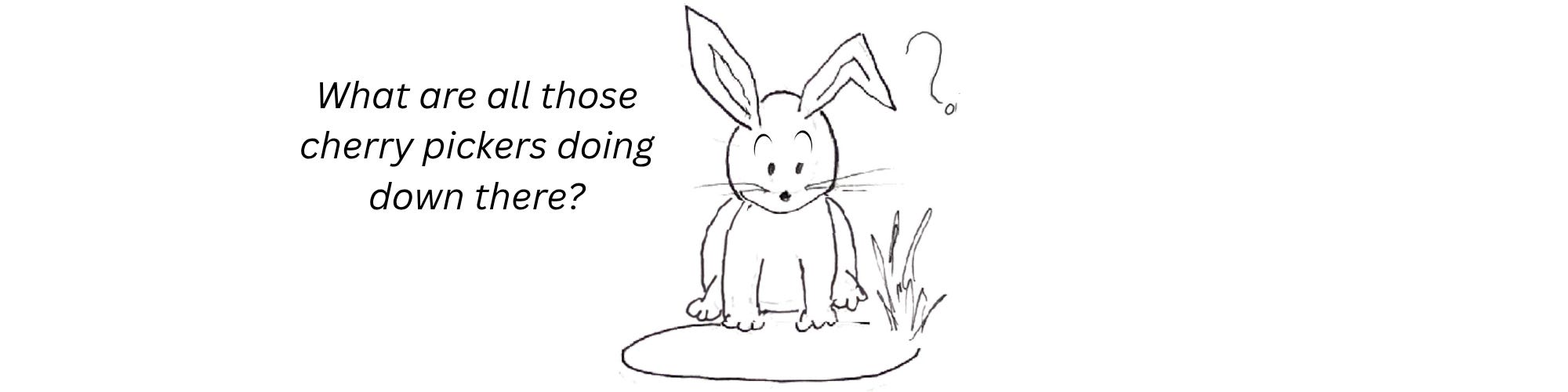
As a researcher aiming to consider all the evidence, I listen to counterarguments. But I’m often trapped in topics that aren’t my area of expertise. Or theirs. I’m caught flat-footed by my opponent’s assertions. Is that true, I ask myself? Back at my computer I search for the answers, diving into the argument’s rabbit holes. Studies show it’s likely I’m looking for evidence that proves me right and them wrong. I can emerge even more dug in, feeling better armed for the next fracas.
Cue Monty Python’s “Argument Clinic”
Whatever the fraught topic, there’s a pattern, a consistent sequence that traps us in an endless loop of disagreement. Here’s a take on it (in pseudocode) that I think you’ll recognize.
PROGRAM: POLARIZED WORLD

READ INPUT FILE #1
Major Areas of Complete and Utter Disagreement, 1–100

READ INPUT FILE #2
Presumed Basic Causes of Major Areas of Complete and Utter Disagreement, including but not limited to:

• Corrupt, Evil, or Deeply Misguided Individuals
• Corrupt, Evil, or Deeply Misguided Groups
• Conspiracies I Know to Be Confabulated
• Love of Money and Power Above All Else
• Failure to Actually Look at the Evidence
• Failure to Recognize Obvious Conflicts of Interest
• Government Overreach
• Government Failure to Act
• Lies and Manipulation by Media, Leaders, and Other Power Brokers
• Corporate Malfeasance to Keep Investors Happy
• People Who Don’t Love America

READ INPUT FILE #3
Information Sources, 1–10

ASSIGN INFORMATION SOURCES
Combatant #1 accesses Sources 1–5
Combatant #2 accesses Sources 6–10

DEFINE “YOU’RE WRONG BECAUSE” ARRAY
1 = Court decision(s) found the opposite
2 = “Independent” research proved the opposite
3 = Whistleblower reported the opposite
4 = Other “credible” source asserted the opposite
5 = I saw the video
6 = I’m pretty sure you’re wrong based on some stuff I’ve heard

SUBROUTINE: SET-STAGE-FOR-ARGUMENT

Choose Major Area of Complete and Utter Disagreement = X
Consult INPUT FILE #2
Assign Basic Cause = C
Assume C explains X
Lock C for duration of argument

SUBROUTINE: HAVE-AN-ARGUMENT

Combatant #1:
Assert position on X

BEGIN LOOP

Combatant #2:
Reject Combatant #1’s Information Sources as biased or corrupt
Consult approved Information Sources
Select supporting evidence
Invoke Presumed Basic Cause C as needed
Assert: “You’re wrong because ______.”

Combatant #1:
Reject Combatant #2’s Information Sources as biased or corrupt
Consult approved Information Sources
Select supporting evidence
Invoke Presumed Basic Cause C as needed
Assert: “No, YOU’RE wrong because ______.”

IF both Combatants still standing AND Subject exhausted:
Run SET-STAGE-FOR-ARGUMENT
Combatant #1:
    Assert position on new X

ELSE:
Continue arguing about current X

REPEAT LOOP

UNTIL:
Agreement is reached

EXPECTED RESULT:
Infinite loop
Note on possible run-time errors: If one of the Combatants is not armed with facts from approved Information Sources, they may abort the loop, unable to adequately rebut what they are certain is dead wrong, storming off in anger or tears. If both Combatants are poorly armed with facts, the argument will degenerate into exclusive use of position #6 in You’re Wrong Because array – “I’m pretty sure you’re wrong based on some stuff I’ve heard.” Both Combatants will feel a bit stupid and privately vow to spend more time studying approved Information Sources in the future to confirm their opposite truths. In moments of unusual clarity, they confront the impossibility of becoming well versed in the many issues for which they hold both vague knowledge and strong beliefs.
Haven’t we always been polarized? Has it gotten worse?
Yes and yes. Polarization is so pervasive that is has become a field of study with its own lingo. “Othering” is our belief that those other people are fundamentally different from us. “Aversion” is what we feel for them. “Moralization” is our conviction that they are morally inferior. “Perception gaps” open when we’re convinced our opponents are more extreme than they really are; these gaps are the rule, not the exception.1
Our differences often line up with our politics. If you think the other political party is immoral, you’re not alone. In a 2022 Pew Research Center survey, 72% of Republicans said Democrats were more immoral than other Americans, while 63% of Democrats said the same of Republicans. Just six years earlier, those numbers were 47% and 35%, respectively.2
If you hold views that are consistently conservative or liberal, you’re not alone. Pew found that the political bell curve has been hollowing out in the middle, with more of us hewing to either end.3 This isn’t new: a Cato Institute research brief found that an index combining eight measures of political polarization increased 28% over the 20 years leading up to the 2016 election.4
Our differences aren’t inherently Republican or Democratic. But increasingly, political party has become the container that holds them. Issues that once cut across party lines now cluster around party identity, leaving less political middle ground. These days, you can easily find yourself among friends, family, or colleagues where “Republican” or “Democrat” is hurled as an insult.
Ultimately, polarization can rupture friendships, fracture families, and paralyze Congress so that its powerless to address any of the issues we care about. We no longer work through disagreements, we simply repeat them.
Announcements at my Episcopal church last Sunday included an opportunity to hear from an expert on how Christian Nationalism is “destroying Democracy.” It may well be a viewpoint worth considering, but it’s disappointing to hear “othering” language in a place where I’ve seen so many examples of the opposite.
I find these trends disheartening. In my writing break today I reminded myself of Saint Thomas Aquinas’s concept of love, which is to will the good of the other. If we were all experts at willing and choosing good for other people, we’d escape these traps, for sure. Short of full-on success in that arena…
Some ways out
Take a walk: This one is so simple it’s tempting to say “That’s stupid” until you try it: When you sense social gravity luring you into a new conflict trap, take a walk instead. Look around. Keep walking until you feel better and things seem brighter. You’ll find you’re better able to escape gravity’s pull and keep at your life’s actual work.
Try “De-Othering” - We can dissolve othering. Talk to the other guy. Find some things you have in common. Stay curious about their ideas. Be open to the possibility that they have part of the truth, too - even when your first instinct was to judge them as delusional and duped. Move from proving your point to asking questions. This is called a “Learning Conversation” in polarization parlance.5 It’s a fruitful place to hang out.
Create a new definition of “win”: Everybody loves to win, but winning doesn’t have to mean changing your opponent’s mind. Winning could simply mean de-othering. It could mean that you’re still speaking to your relatives at the end of Thanksgiving weekend - or even better, that you give each other genuine hugs goodbye. That you stay open and learn something new in the moment. That you come away with a question you dive into later or that you find a few things you agree on and realize you’re not as far apart as you thought. Look for these winning outcomes in thorny conversations.
Help change the daunting: Can we loosen the grip of systems that keep us polarized and paralyzed, socially and politically? Could we push for Congressional term limits, shake loose the two-party system, draw clearer boundaries around executive power, get Congress moving on good stuff and out of its social media war, rein in political contributions and hidden PAC money and the rampant spread of false information as fact, and instead earnestly address climate change, AI risks, plastic pollution, social media harms, finance industry dysfunction, and more? These have yet to prove doable. But – of course - if everybody chose one and put some energy into it, we could begin to break the ossified chokeholds.
It’s fun to win an argument, or at least more fun than losing one. But if changing minds defines the win, there’s no way to succeed when all sides are plastered to the extreme edges of the spectrum. The big point isn’t to prove yourself right against an opponent convinced you’re wrong. It’s to avoid the trap in the first place, and to give your energy to the people and causes you care about the most.
For an excellent and concise summary of polarization in America, see this article by a who’s who academic research team: Eli J. Finkel et al. Political sectarianism in America. Science 370, 533-536 (2020). www.science.org/doi/10.1126/science.abe1715.
Pew Research Center. 2022. As Partisan Hostility Grows, Signs of Frustration With the Two-Party System. Nearly half of younger adults say they ‘wish there were more parties to choose from’. August 9 2022. https://www.pewresearch.org/politics/2022/08/09/as-partisan-hostility-grows-signs-of-frustration-with-the-two-party-system/.
Pew Research Center. 2014. Political Polarization in the American Public. How Increasing Ideological Uniformity and Partisan Antipathy Affect Politics, Compromise and Everyday Life. June 12 2014. https://www.pewresearch.org/politics/2014/06/12/political-polarization-in-the-american-public/.
Cato Institute. 2017. The Internet, Political Polarization, and the 2016 Election. Research Briefs in Economic Policy No. 88 by Levi Boxell, Matthew Gentzkow, and Jesse M. Shapiro. Nov 1 2017. https://www.cato.org/research-briefs-economic-policy/internet-political-polarization-2016-election.
Stone D, Patton B, & Heen S. 2023. Difficult conversations: How to discuss what matters most. Penguin Books.